November 23, 2026
Fifty-five years ago, western Illinois declared itself a new republic as a joke — complete with a governor, a capital in a hamlet nobody could find, and a white flag for a national banner. This month, the joke’s home county voted to explore leaving Illinois for real. Well, as real as an advisory referendum gets.
On Tuesday, Nov. 3, voters in 12 more Illinois counties approved nonbinding referendums asking whether their county boards should talk with other counties about separating from Cook County and forming a new state. The results bring the total to 45 of Illinois’ 102 counties that have voted yes since 2020, according to a Fox 32 Chicago county-by-county review. The Center Square counts it slightly differently — 44 counties plus 11 townships in Adams County — because Ford County’s question was worded separately from the organized campaign. Either way, nearly half the counties in Illinois have now voted to explore an exit.
The votes, wave by wave
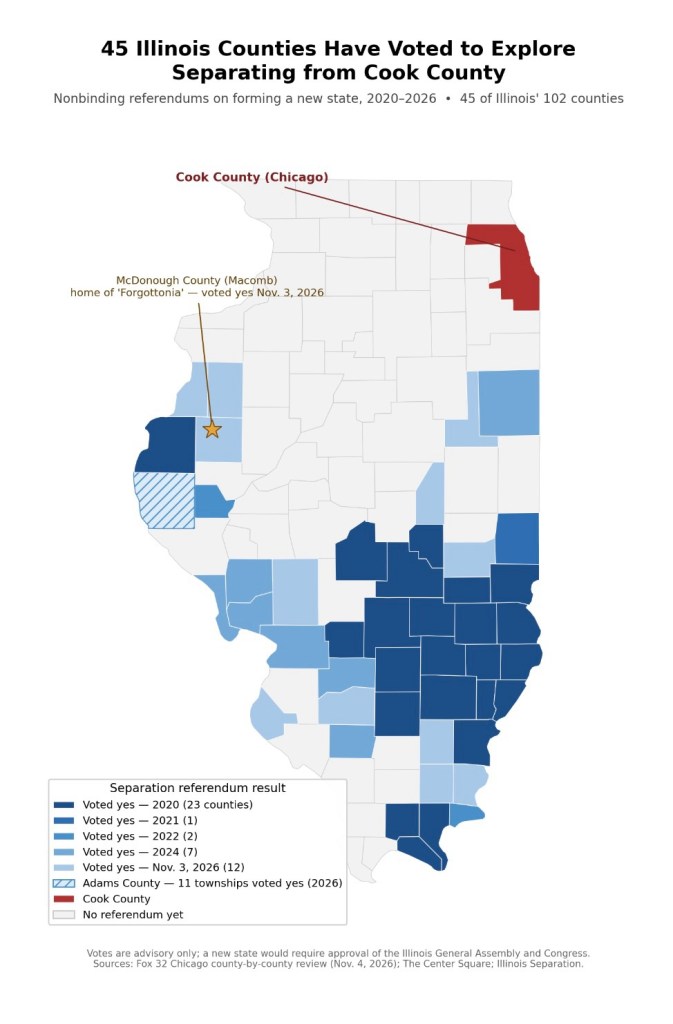
The movement began in 2020. Effingham, Fayette and Jefferson counties passed separation referendums in the March primary, and 20 more followed that November: Bond, Christian, Clark, Clay, Crawford, Cumberland, Edwards, Hancock, Jasper, Johnson, Lawrence, Marion, Massac, Moultrie, Pope, Richland, Shelby, Wabash, Wayne and White. Edgar County followed in April 2021, and Brown and Hardin counties in 2022.
Seven more joined in 2024 — Calhoun, Clinton, Greene, Iroquois, Jersey, Madison and Perry. Madison County, across the river from St. Louis with about 265,000 people, was the first suburban county to pass one, and the closest call yet at 56.5% in favor.
The Nov. 3, 2026 wave added Coles, Gallatin, Hamilton, Henderson, Macoupin, McDonough, Monroe, Piatt, Saline, Warren and Washington counties, plus Ford County on its own wording, plus 11 townships in Adams County that voted 79% to 90% yes. Hamilton County was the strongest full county at 80%. McDonough County was the closest at 57%.
The standard ballot question asks: “Shall the board of [the county] correspond with the boards of other counties of Illinois, outside of Cook County, about the possibility of separating from Cook County to form a new state and to seek admission to the Union as such, subject to the approval of the people?” Across the 2020-2024 votes, the yes side averaged about 74%.
Why they want out
Cook County holds about 40% of Illinois’ population, and the wider Chicago metro area about 75%. Downstate supporters say that math leaves them outvoted and overlooked in Springfield.
“The state legislature tends to not take us into consideration when they’re making their laws,” said Loret Newlin, director of Illinois Separation, the group behind the referendum campaign. Newlin says the goal is an entirely new state — not absorption into Indiana.
Indiana has made its own pitch. In January 2025, Indiana House Speaker Todd Huston proposed annexing the counties that had voted to secede, and an Indiana-Illinois Boundary Adjustment Commission was proposed in both states. “Hey, don’t start a 51 state, we would love to have ya in Indiana,” Huston told Fox Chicago, pointing to Indiana’s lower taxes and noting more than 100,000 people have moved from Illinois to Indiana since 2020. Gov. JB Pritzker rejected the idea, and in 2024 said separation proposals “should not be on the ballot.”
The reality check
None of these votes changes any boundary. In October 2023, Attorney General Kwame Raoul issued an opinion that the Illinois Constitution does not allow counties to secede and that the referendums have no binding legal effect. Carving a new state out of Illinois would require the consent of both the Illinois General Assembly and Congress — the same legislature downstate voters say ignores them. No U.S. state has been divided since West Virginia separated from Virginia during the Civil War.
The funding complaint also cuts both ways. A Southern Illinois University Paul Simon Public Policy Institute study of 2013 tax and budget records found downstate regions receive more state funding than they pay in: about $2.81 per tax dollar in Southern Illinois and $1.87 in Central Illinois, compared with about 90 cents for Cook County and 53 cents for the suburbs. SIU’s John Jackson has called the referendums a symbolic statement of discontent rather than a practical plan.
Supporters say the statement is the point — and they’re not done. Seven counties already have contacts lined up for 2028 referendum petitions: Adams, Kankakee, Franklin, Tazewell, Vermilion, Whiteside and Woodford.
The joke that said it first
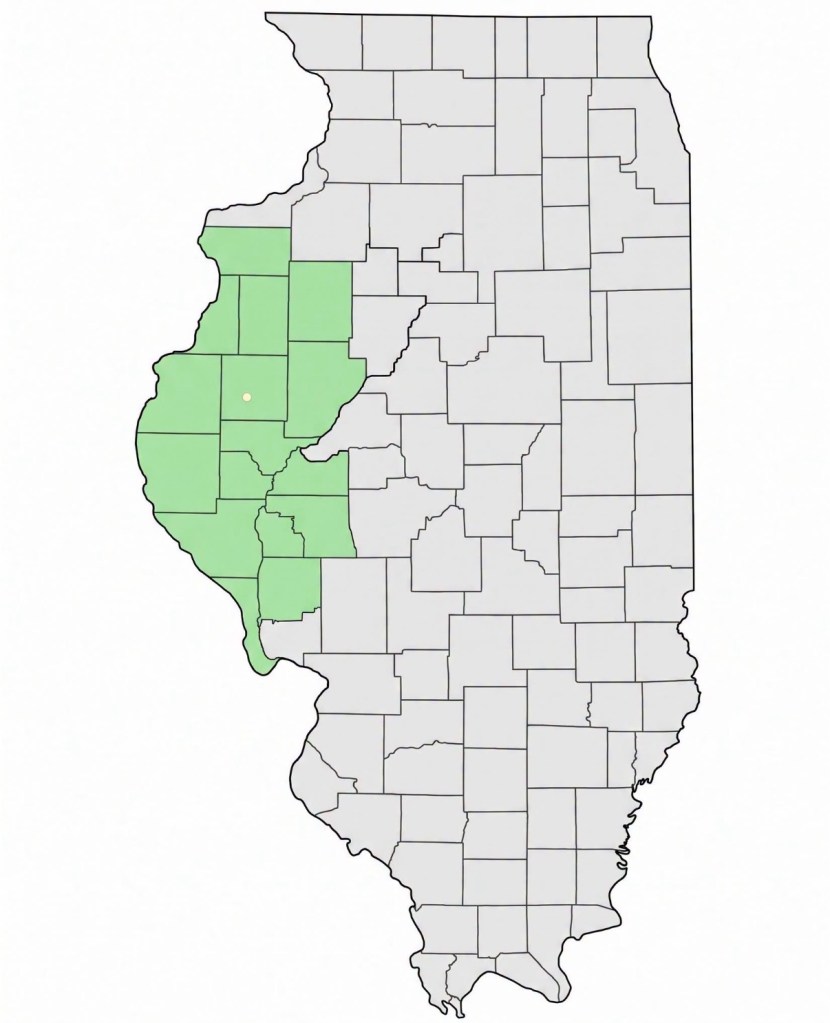
The idea of a downstate breakaway is older than the referendums — and it started as comedy. In the late 1960s and early 1970s, 16 counties in the western bulge of Illinois, between the Mississippi and Illinois rivers, felt left off the map: Adams, Brown, Calhoun, Cass, Fulton, Greene, Hancock, Henderson, Knox, McDonough, Mercer, Morgan, Pike, Schuyler, Scott and Warren.
The passenger train to Chicago stopped running in 1970. Carthage College had moved to Wisconsin in 1964. Congress passed on the Chicago-to-Kansas City expressway three different times. The region didn’t even have a public television station. Folks felt the rest of the country was driving right around them.
So in 1971, Macomb Chamber of Commerce men Jack Horn and John Armstrong made a joke out of it. They declared the region the Republic of Forgottonia, with its capital in Fandon, a tiny hamlet south of Colchester in McDonough County. Their governor was Neal Gamm, a Western Illinois University theater student and Vietnam veteran, who posed in a frock coat, bow tie and boutonniere in front of hand-lettered signs for the “Governor’s Mansion” and the “Republic of Forgottonia Capitol Building.” The republic’s flag was a blank white sheet — the flag of surrender. The plan, as Gamm later recalled it: “We would secede from the Union, immediately declare war, surrender, then apply for foreign aid.”
Everyone in on the gag knew it was satire, and reporters loved it. The story traveled from Macomb to the New York Times and beyond. The humor carried a real message — rural communities pay taxes and send their kids to school like everyone else, and they wanted a fair share of the roads, rails and funding. Amtrak brought passenger service back to the region in 1972. The expressway never arrived, but the point had been made loud and clear.
Today the name is worn with pride. The Macomb visitors bureau rebranded as Visit Unforgettable Forgottonia. A Cuba High School teacher and his students started the Forgottonia Project to tell the region’s stories. Local tourism groups use the name to promote festivals and history.
The punchline, 55 years later
Here’s the part nobody in Fandon could have scripted: the old joke republic’s counties are now voting on the real question. Hancock County voted yes in 2020. Brown County in 2022. Greene and Calhoun in 2024. Henderson and Warren counties — and 11 Adams County townships — joined them on Nov. 3.
And McDonough County itself, home of Macomb, Western Illinois University and the onetime capital of Forgottonia, voted 57% to 43% to explore separating from Cook County — the closest result of the year. Newlin admitted she had been concerned McDonough might not pass at all.
Forgottonia never seceded. Its governor surrendered on schedule, and the republic faded into a state of mind. But the grievance underneath the gag — that downstate Illinois is an afterthought in its own state — never went away. It just traded the white flag for a ballot question, and 45 counties have now answered it the same way.
Sources: Fox 32 Chicago (Nov. 4, 2026); The Center Square via the Hometown Register (Nov. 2026); WCIA and NPR Illinois (2024); Southern Illinois University Paul Simon Public Policy Institute; Visit Unforgettable Forgottonia and the Illinois House Republican Caucus blog on Forgottonia; county referendum records compiled by Illinois Separation. County totals: Fox 32 counts 45 counties; The Center Square counts 44 counties plus 11 Adams County townships, the difference being Ford County’s separately worded referendum.

